Impacted Wisdom Teeth Richmond VA
What Is An Impacted Tooth?
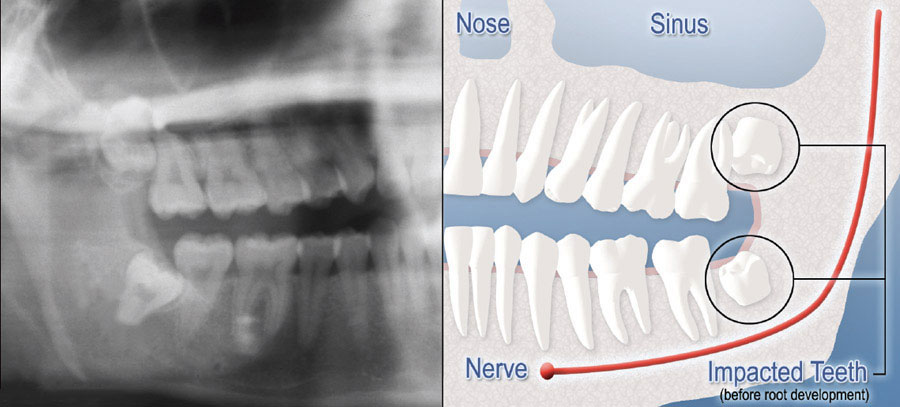
Although most people develop and grow 32 permanent adult teeth, many times their jaws are too small to accommodate the four wisdom teeth. When inadequate space prevents the teeth from erupting they are called impacted. This indicates their inability to erupt into the proper position for chewing and cleaning.
Types Of Impactions
We will need to see you for a consultation to determine if you will benefit from wisdom tooth removal. A special x-ray of your mouth and jaws (panorex) will be taken to determine if your wisdom teeth are impacted, if there is room for them to erupt, and how difficult it will be to have them removed. If removal is recommended, your surgical team will also explain what to expect during healing and provide post-operative instructions for wisdom tooth removal to help you prepare for recovery.
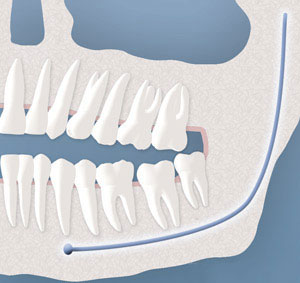
- Soft Tissue Impaction: There is not enough room to allow the gum tissue to retract for adequate cleaning of the tooth.
- Partial Bony Impaction: There is enough space to allow the wisdom tooth to partially erupt. However, the tooth cannot function properly in the chewing process, and creates cleaning problems, among others.
- Complete Bony Impaction: There is no space for the tooth to erupt. It remains embedded in the jawbone or, if partially visible, may require more complex surgical techniques for removal. The impacted wisdom tooth may also be in an unusual position and difficult to remove. This situation can also arise when the shape or size of the jawbone and other facial structures make removal significantly more complex.
 Soft Tissue
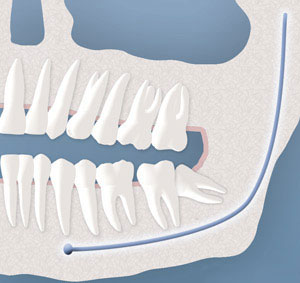 Partial Bony
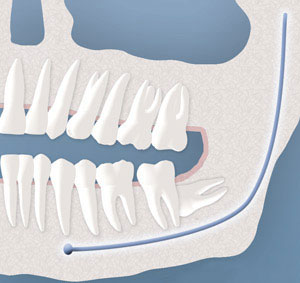 Complete Bony
For oral surgery cases that require more detailed anatomical information, VOFS also offers 3-D imaging using cone-beam CT technology. Your surgeon can determine whether this type of imaging is appropriate as part of your treatment planning.
Symptoms and Risks of Impacted Wisdom Teeth
Impacted wisdom teeth do not always cause noticeable symptoms right away. When problems develop, you may experience pain or pressure toward the back of the mouth, swelling, tenderness around the gums, or difficulty chewing or swallowing. Partially erupted wisdom teeth can also be difficult to keep clean, increasing the risk of irritation or infection around the tooth.
Depending on their position, impacted wisdom teeth may contribute to other oral health problems, including:
- Infection: Gum tissue around a partially erupted wisdom tooth can become irritated and infected, sometimes causing recurring pain and swelling.
- Decay and gum disease: Difficulty cleaning around an impacted tooth can increase the risk of cavities and periodontal problems affecting both the wisdom tooth and the neighboring second molar.
- Damage to nearby teeth: An impacted wisdom tooth may affect the tooth directly in front of it, contributing to decay, gum disease, or bone loss.
- Cysts: Fluid-filled cysts can sometimes develop around impacted wisdom teeth and damage the surrounding bone or nearby teeth.
- Crowding or orthodontic concerns: Impacted wisdom teeth may be one of several factors that contribute to changes in tooth alignment.
If you are experiencing symptoms or have been told that your wisdom teeth are impacted, a VOFS oral surgeon can evaluate their position and determine whether monitoring or wisdom teeth removal may be appropriate. Virginia Oral & Facial Surgery provides impacted wisdom teeth evaluation and treatment at multiple locations throughout the greater Richmond area.
Do You Want Your Wisdom Teeth Removed?
If your wisdom teeth are causing you pain or you want to avoid future problems, contact our office to schedule an appointment.
Frequently Asked Questions
Impacted wisdom teeth are third molars that do not have enough room to erupt into a normal position for chewing and cleaning. They may remain beneath the gum tissue, be partially surrounded by bone, or stay completely embedded in the jaw.
Impacted wisdom teeth do not always cause symptoms right away. When problems develop, you may notice pain or swelling toward the back of the mouth, tenderness around the gums, or difficulty chewing or swallowing. Partially erupted wisdom teeth can also be difficult to clean and may contribute to infection around the tooth.
VOFS classifies wisdom teeth as soft tissue, partial bony, or complete bony impactions. A soft-tissue impaction occurs when there is not enough room for the gum tissue to retract around the tooth. A partial bony impaction means the tooth has partly erupted but remains restricted by bone, while a complete bony impaction remains embedded in the jawbone and may require a more involved surgical approach.
Your oral surgeon will examine your mouth and use a panoramic X-ray, or panorex, to evaluate the position of the wisdom teeth, whether there is enough room for them to erupt, and how difficult removal may be. A consultation also helps determine whether wisdom tooth removal is recommended.
Removal may be recommended when an impacted wisdom tooth does not have enough room to erupt normally or creates a risk of problems such as infection, cyst formation, gum disease, decay, bone loss, or damage to the neighboring second molar. Your VOFS oral surgeon will evaluate the position of the teeth and discuss whether wisdom teeth removal is appropriate.
Impacted wisdom teeth may remain problem-free for a period of time, but they can also contribute to recurring infection, cysts, gum disease, bone loss, decay, or damage to nearby teeth. VOFS also notes that when impacted wisdom teeth require removal later in adulthood, healing can be slower and the risk of complications may increase.